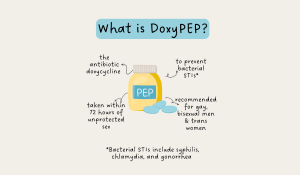
Is Doxy PEP Responsible for a Drop in STI Rates in San Francisco?
New data shows that cases of bacterial STIs have dropped dramatically in San Francisco. Public health officials in the city believe doxy PEP has helped drive these declines.

 HPV, abnormal Pap tests, follow-up exams and treatments are confusing for the women dealing with them, but what about the boyfriends and husbands? There aren’t many resources to help a baffled guy understand what’s going on with HPV, or how to best support the woman in his life who’s dealing with a diagnosis. Danielle Sepulveres, author of Losing It: The Semi-Scandalous Story of an Ex-Virgin, offers a quick FAQ to help men get a clue.
DS: You get that sinking feeling in the pit of your stomach. Most often, there are no symptoms or any warning that something might be abnormal. You just think you’re going in for the annual checkup and then you get a phone call that something’s not quite right. It’s really scary, especially when it happens at a young age (I was 23), because there’s no way you’re prepared for it or expecting to hear something like that.
He needs to put his girlfriend or wife first. My boyfriend didn’t understand what was happening, so I spent most of the time reassuring him when it should have been the other way around. Instead of going into a panic yourself, she really needs you to be the more stable person. Get yourself informed and educated, and consider going to her appointment so you can ask questions, too. She needs to focus on keeping her cool and calm, so it’s not helpful if the man is just adding to her stress.
That’s true, which is why it’s a two-way street and he also needs to be informed. My doctor was wonderful and told me repeatedly that my boyfriend was more than welcome to come and ask questions, and I think most doctors have a similar mentality. They know the guy probably doesn’t understand what’s going on and would like information. I think the main things are to be supportive, be informed, and know what it is you’re talking about instead of blindly fumbling around the subject.
It was funny for me because I’d never heard of colposcopy and I kept thinking he was saying “colonoscopy”, and I was thinking “What’s THAT got to do with all this?”
It was somewhat painful for me to go through the colposcopy/biopsy; I wasn’t quite prepared for it because a Pap test is so quick, painless, and easy. They had warned me that colposcopy takes longer than a Pap, as they really have to ‘scope you and see what’s going on, so it’s not as quick and simple. Unlike a Pap, with a colposcopy there’s a tendency to have cramping and discomfort from the speculum being inserted for such an extended period of time.
So I found it to be really uncomfortable, even after it’s over. It feels as if your body is rejecting whatever was happing to it, foreign, unnatural feeling of the exam. I remember thinking “Uh oh, if the biopsy shows there really are precancerous cells, what happens next? If this is so uncomfortable, what might an actual treatment be like?” My mind was already racing ahead!
I was fine by the next day. I felt kind of nauseous and sick to my stomach for the rest of the day, and I’m sure stress and nerves contributed to that. I just didn’t feel well for a day or so.
I would say he should set her up on the couch or in bed with DVDs of movies she likes, make her dinner but something she can handle in case she’s not feeling well, something light like chicken noodle soup or a comfort food. If she wants to talk about the experience or explain what she’s feeling let her do so, but also respect her and give some space if she doesn’t want to talk about it.
I was terrified. I had read maybe one article about HPV and cervical cancer in Cosmo, but hadn’t paid much attention otherwise. My doctor called my work line to deliver my Pap test results, which made me think it was more urgent and “God, this can’t be good!” In the conversation he was reassuring, though, and stressed how common HPV is. He explained how we have options; the abnormal cells are something we can work with.
It just never even occurred to me I was at risk! I was angry about it, and it just felt unfair. I’m faithful, monogamous, only one partner, but there you go.
How long does it take to turn into cancer? How do you get rid of it? What if you can’t get rid of it? I also wondered about being with my partner, and if we’d just keep giving it back and forth. I had so many questions, and was lucky to have a doctor who was constantly educating himself so he had the most up to date information. As nervous as I was, my confidence in my doctor made me feel better. I trusted him 100%, feeling sure he knew what to do for me. Having a good rapport with your doctor is essential.
They should know the woman feels tired and maybe a bit nauseous. With cryotherapy, the cervix if being frozen which means it has to “melt” and recover, so for the next few weeks -as my doctor put it – the abnormal cells are just popping off and leaving your body. I was just hoping it was working! But it feels like your body is not your own for a few weeks. The second round I had was more intense than the first, so I really didn’t feel well after that one. Even the next day felt a little bit off.
With LEEP, they talk about removing part of your cervix which can potentially cause issues for women who want to get pregnant later. LEEP doesn’t prevent women from getting pregnant, but it can cause some issues when you are pregnant (like premature delivery), and from what I was told it’s just something that needs to be monitored a little more closely versus a woman who hasn’t had a LEEP. Men should know there are so many thoughts racing through her mind, so many worries over things like this.
So again, I encourage guys to do their best to be informed, be supportive, and don’t hesitate to ask questions. I think sometimes men are uneasy to bring it up, but it’s better to ask questions and know rather than being afraid to talk about it. It’s good for the woman to see he’s involved, engaged, and just making an effort to be there for her.
New data shows that cases of bacterial STIs have dropped dramatically in San Francisco. Public health officials in the city believe doxy PEP has helped drive these declines.

A new report shows that fewer women are getting prenatal care. That means too many patients are missing the chance to prevent congenital syphilis.

Condoms. All sorts of shapes, sizes, colors (even glow-in-the-dark). Ribbed or plain. Lubed or not. Latex or plastic. ASHA’s Fred Wyand shares his thoughts on this reliable way to prevent STIs and pregnancy.

Syphilis rates in pregnant women went up 222% percent between 2016 and 2022 and another 28% between 2022 and 2024. Too many pregnant women are not being screened.

Currently, condoms are the only widely available, proven method for preventing pregnancy and reducing transmission of HIV and other sexually transmitted infections (STIs) during sex. Condoms work.

Three organizations—ACS, ACOG, and HRSA—have each recently endorsed new guidelines for cervical cancer screening. All of them discuss screening with self collected samples.

Research suggests that only one dose of the HPV vaccine may be effective enough to prevent HPV-related disease, including cancer.

Australia has been a leader in cervical cancer prevention for decades and is now close to eliminating the disease.

We need to know if we can keep you company during this visit. We are useful for making this site work.