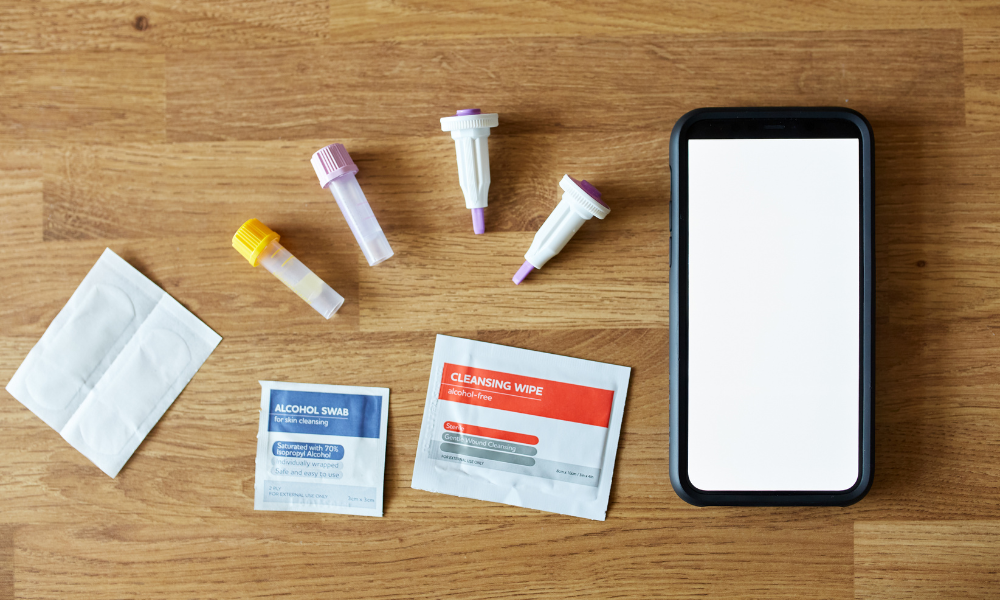
Testing for sexually transmitted infections at home isn’t entirely new. The first HIV home test collection kit was approved way back in 1996. But now there are many more options (including free ones) to test in the comfort and privacy of your own home.
Some STI at-home tests will give you results quickly. You collect your sample, do the test, and get your result at home. An example of this is the at-home syphilis test that can give a result in about 15 minutes.
Other at-home STI tests let you collect your own samples at home (like urine or blood), but you don’t get the results right away. Instead, you send the samples to a lab. The lab does the test and provides results within a few days.
The answer to this question is different for everyone because it can depend on factors like your age and your behavior. For example, younger people, especially women, are biologically more susceptible to STIs. Additionally, certain groups (like men who have sex men) may have higher STI rates in their communities. If a person has multiple sexual partners, they may also need to test more often.
In general, everyone should be tested for HIV at least once in their lives and anyone who is sexually active should be tested for most STIs about once a year. Some people may want to be tested more frequently if they have multiple partners and some people may need fewer tests because they have only one partner and are sure their partner doesn’t have any other partners. Check for an explanation of CDC’s specific recommendation for each STI.
Home testing is best used as a method for regular screenings. If you have symptoms such as genital itching, burning, or unusual discharge it can be better to see a health care provider because a physical exam can help you get a quick and accurate diagnosis and start treatment right away.
You can test for most STIs at home. Some tests can be bought at pharmacies, like a new home test for syphilis. Others can be purchased online, like a new FDA-approved home test for chlamydia, gonorrhea, and trichomoniasis. While herpes tests are available for home use as well, blood tests for HSV are considered less accurate and are known to return a significant number of false positive results.
There are many ways to get an STI test that you can do at home. You can get them over the counter in some pharmacies. Or you can go online where a number of companies such as Nurx, TBD Health, Lemonaid, Let’s Get Checked, and myLAB box sell home test kits. Many of these companies will mail out a test kit for you to use at home and mail back. Others connect you to an online provider, either through telehealth or an online survey, who will write an order for you to go to a local lab where you will provide samples (not quite at home but still avoids the need for an in-person doctor’s appointment).
Some health departments are also offering at-home test kits that you can pick up or have mailed to you.
Free at-home testing kits are also available in some areas—check below for more information.
While health departments often offer their test kits for free, other providers have a wide range of pricing. A CVS test kit sells for $99. Most of the online companies seem price their test kits at about $99 as well but they also offer more comprehensive kits (that test for additional STIs) that are more expensive. Some can be over $200. Some companies offer a membership program so that people who want to be tested frequently can receive a discount.
While there may be exceptions for tests ordered by a telehealth provider and done at a local lab, for the most part home STI tests are not covered by insurance. For a test purchased at a pharmacy, like CVS, it may be possible to use funds from an HSA plan, if you have one.
Check below to see what free options may be available near you.
Each test kit will be a little different. Tests for HIV and syphilis may ask you to prick your finger and put a drop of blood on a test card or fill up a tube. Tests for gonorrhea, chlamydia, and trichomoniasis may require a urine sample or a vaginal swab. Depending on what you are testing for, some kits may also ask for a vaginal swab, an anal swab, and/or a throat swab.
There is also a rapid HIV test that uses a sample of saliva collected by swabbing your gums.
While COVID-19 home tests have gotten us used to instant results, most STI tests don’t offer quick, at-home results. Only the rapid HIV test done with an oral swab, a new syphilis test, and a new test for chlamydia, gonorrhea, and trich provide at-home results.
All other home STI tests involve collecting the samples yourself and sending them to a lab that will analyze them and provide the results. This can take a few days to a week or so once you’ve sent the sample back.
Each test kit will come with instructions on how to access your results. Typically, you’ll need to log on to a website to get test results.
For most STIs, home tests should be as accurate as the tests done in a doctor’s office because they are being conducted in a laboratory. That said, the only tests that have been approved for home use by the FDA are those that test for HIV, syphilis, and a test for chlamydia, gonorrhea, and trichomoniasis (only for women). The lab tests for other STIs were approved by the FDA using samples collected by health professionals and the agency is still questioning whether the tests remain as effective when the samples are collected at home.
Experts seem to agree that home tests for chlamydia, gonorrhea, trichomoniasis, and hepatitis-C are reliable. When it comes to herpes, however, there are fears that the tests will return too many false positives. Even so, these tests can be valuable by providing reliable negative results. Anyone who gets a positive result on one of these tests will likely be advised to seek additional testing to confirm.
Stay calm. If you do have an STI, you are not alone—it is estimated that one in two sexually active people will get an STI in their lifetime. Some STIs can be cured, and others can be treated to manage symptoms. A positive diagnosis means you have the opportunity to treat the STI and either cure it entirely or reduce symptoms and reduce the chance of passing it on.
Most test kits come with access to a health care provider, whether you got the kit from a health department or ordered it online. The provider may be able to offer you treatment via a telemedicine visit or may help you find a provider in your area that you can see in person.
If you test positive for an STI, it is important to follow up with treatment, and also to let partners know that they should be tested as well (health care providers and health departments can help you with this if you don’t want to contact partners yourself).
While there are many commercial options for at-home testing, as mentioned above, there are also free options in some areas of the country, typically offered in coordination with health departments.
ASHA believes that all people have the right to the information and services that will help them to have optimum sexual health. We envision a time when stigma is no longer associated with sexual health and our nation is united in its belief that sexuality is a normal, healthy, and positive aspect of human life.
ABOUT
GET INVOLVED
ASHA WEBSITES
GET HELP
© 2026 American Sexual Health Association

We need to know if we can keep you company during this visit. We are useful for making this site work.
We use cookies to enhance your browsing experience. You can choose which cookies you want to accept.
Necessary cookies help make a website usable by enabling basic functions like page navigation and access to secure areas. The website cannot function properly without these cookies.
| Cookie | Provider | Purpose | Expiry |
|---|---|---|---|
digiconsent | This website | Stores your cookie consent preferences. | 1 year |
wordpress_logged_in_* | WordPress | Identifies logged-in users and their authentication details. | 14 days / Session |
wordpress_sec_* | WordPress | Stores authentication details for secure areas. | 14 days / Session |
wp-settings-* | WordPress | Stores user interface customization preferences. | 1 year |
wp-settings-time-* | WordPress | Stores the time when wp-settings cookie was set. | 1 year |
Analytics cookies help us understand how visitors interact with our website by collecting and reporting information anonymously. This helps us improve our website.
| Cookie | Provider | Purpose | Expiry |
|---|---|---|---|
_ga | Registers a unique ID to generate statistical data on website usage. | 2 years | |
_ga_* | Used by Google Analytics to store and count pageviews. | 2 years |
Marketing cookies are used to track visitors across websites. The intention is to display ads that are relevant and engaging for the individual user.
Functional cookies enable the website to provide enhanced functionality and personalization. They may be set by us or by third party providers.