ASHA remains an independent, unbiased source of information on sexual health. We are guided by science, not ideology. READ MORE.

ACIP Changes Hepatitis B Vaccination Gudiance

An infant with a bandage where a vaccine was administered

A committee that advises the Centers for Disease Control and Prevention (CDC) made an alarming change to the recommendations for the hepatitis B vaccine that will leave some infants unprotected.

Since 1991, the CDC has recommended vaccinating all newborn babies against the virus before they leave the hospital. A second shot is given at one or two months and a third between six and 18 months.

This vaccination campaign has been enormously successful—acute infections among children and teens dropped by 99% between 1990 and 2019. Most public health experts and medical groups strongly believe that the practice was working and did not need any changes. There has been no new research to suggest otherwise.

Despite this, the Advisory Committee on Immunization Practices (ACIP) voted to change the recommendations. It now says that only babies born to women with hepatitis B or women whose status is not known should get the vaccine while in the hospital. Parents of all other newborns should talk to their doctor and make a decision about if/when their baby will get the vaccine.

The changes also impact subsequent doses. The new recommendations say that babies should be tested for antibodies in between doses and the results of those tests should be used to determine if/when they get additional doses. Experts say this approach has never been tested.

The ACIP says the new recommendations are based on a shared decision-making model designed to give parents more control, but experts say it will only cause confusion.

Hepatitis B is Highly Contagious

The hepatitis B virus is passed through contact with infected body fluids such as blood, semen, and vaginal secretions. It can be passed on through oral, anal, and vaginal sex. It can also be passed during injection drug use if people share needles or other equipment.

Most babies who get hepatitis B get it from their mothers during birth. It is recommended that pregnant women get tested for hepatitis B before they give birth, but some women don’t have access to the prenatal care they need and may not be screened during pregnancy.

The virus is passed on in other ways as well. Hepatitis B virus can live outside the body—on surfaces in our homes, schools, and public places—for up to seven days. It is still infectious during that time. This means that the virus can be transmitted from a family member to a child at home through items like toothbrushes, razors, and nail clippers. It also means that children can transmit the virus to each other through biting (which is common in day care settings), playground accidents, or contact with blood during sports. The blood does not have to be visible to be infectious.

Vaccinating all newborns for hepatitis B within 24 hours of birth protects them from contracting the virus during delivery and as they grow.

Hepatitis B is Dangerous in Young Children

Hepatitis B attacks the liver. Initial or acute infection with hepatitis B may be mild and have few, if any, symptoms. Many people who get an acute infection clear the virus on their own without treatment. Once a person has cleared the virus, they can’t be infected with hepatitis B again.

Other people who contract hepatitis B don’t clear it and develop a chronic infection, which can last for their entire lives. Over the course of a lifetime, chronic infection can lead to liver damage, liver failure, liver cancer, or even death.

Hepatitis B is especially dangerous for babies and young children. Babies who are infected with hepatitis B at birth or during the first year of their lives have a 90% chance of developing a chronic infection. Young children who are infected between ages one and five have about a 30% percent chance of developing a chronic infection.

One quarter (25%) of babies and young children who develop a chronic infection will die from the disease.

The Hepatitis B Vaccine is Safe and Effective

Some members of the ACIP have said that a shared decision-making process is necessary because parents need to better understand the risks that come with vaccination, but the risks are very low. Over a billion doses of the hepatitis B vaccines have been given worldwide since 1982. The most common side effects are mild and include headaches, fever, or soreness at the injection site.

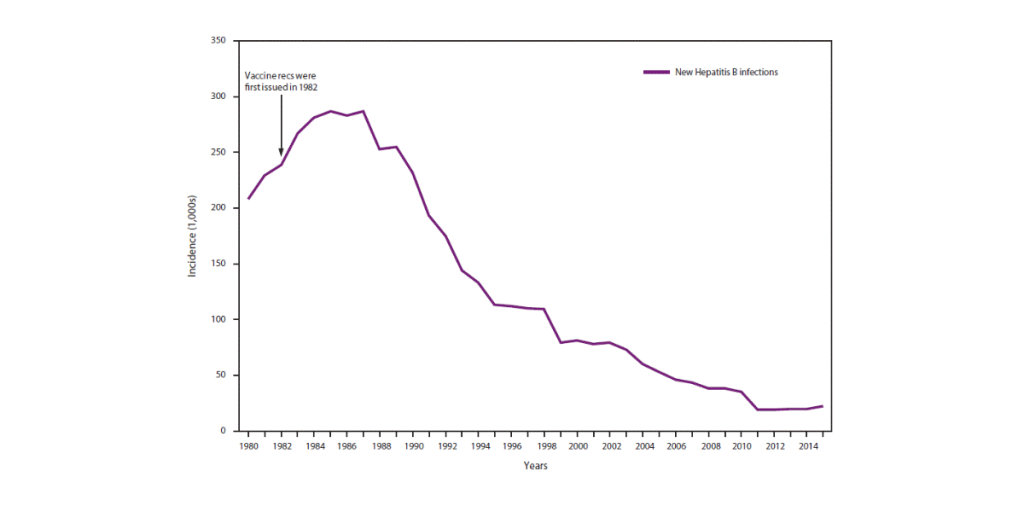
We also know that the vaccine works to protect young people and adults. As this chart shows, the rate of reported acute hepatitis B infections declined 88.5% since the vaccine was first recommended in 1982, from 9.6 cases per 100,000 population to 1.1 cases per 100,000 population in 2015.


Graph showing the decline of hepatitis B infection after the vaccine was introduced
The rate of reported acute HBV infections declined 88.5% since recommendations for HepB vaccination were first issued, from 9.6 cases per 100,000 population in 1982 to 1.1 cases per 100,000 population in 2015

Getting the shot early in life is best. As we said earlier, since the United States began recommending universal vaccination before babies left the hospital, the rate of hepatitis B in children and teens dropped 99%.

Politics Influenced the Decision

The ACIP’s decision seems to be based more on politics than it is on science or medicine. Robert F. Kennedy, Jr, who is the Secretary of Health and Human Services, has been a vocal opponent of vaccines for decades. He founded one of the largest anti-vaccine groups and continues to spread misinformation about vaccines even in his current role. In June 2025, Kennedy fired all 17 members of the ACIP and replaced them with new members many of whom share his anti-vaccine views.

Dr. Cody Meissner, a professor of pediatrics at Dartmouth’s Geisel School of Medicine, is the only member of the committee who had served on it before Kennedy. He voted against the change: “The hepatitis B vaccine recommendation is very well established. We know it is safe, and we know it is very effective.” He said the change would lead to more people infected with hepatitis B in the future, “Do no harm is a moral imperative. We are doing harm by changing this wording.”

The American Academy of Pediatrics also strongly opposes this change. The group’s president, Susan J. Kressly, M.D., FAAP, called the guidance “irresponsible and purposely misleading.” She went on to say, “I want to reassure parents and clinicians that there is no new or concerning information about the hepatitis B vaccine that is prompting this change, nor has children’s risk of contracting hepatitis B changed. Instead, this is the result of a deliberate strategy to sow fear and distrust among families.”

A recommendation from ACIP officially becomes part of the CDC immunization schedule once it is adopted by the CDC director. That has not happened yet, but it seems unlikely that the current director will reject the guidance as Kennedy has a lot of influence over the CDC.

Infants Should Get the Hepatitis B Vaccine

The only good news is that even if these recommendations are adopted by the CDC, nothing has to change. The AAP, most mainstream medical organizations, and many state health departments continue to recommend giving newborns a dose of the hepatitis B vaccine within 24 hours of birth and additional doses at 1-2 months and 6-18 months.

Parents who want to protect their children can still vaccinate while in the hospital and follow the existing schedule for the second and third dose. CDC recommendations often determine what procedures insurance companies will pay for, but major insurers have said they will continue to cover vaccines. In fact, the Affordable Care requires them to cover this vaccine.

The bottom line is that vaccinating infants for hepatitis B remains a very important part of keeping them safe and healthy and can prevent them from experiencing life-long—and potentially life-threatening—liver issues.

More to Explore

Mpox

New Type of Mpox Diagnosed in England

Public health officials in England announced that they have identified a new combined type of mpox. Tests show the virus was a unique mix of the two known types of mpox and experts are concerned about what this means for future spread of the virus.

Cases and deaths from vaccine preventable diseases

The Science is Still Clear—Vaccines Work

The Centers for Disease Control and Prevention (CDC) recently made striking changes to its online information about the connection between vaccines and autism that put the agency on the wrong side of science.

A visual representation of herd immunity

Study Shows Herd Immunity for HPV is Possible

We’ve known for years that the HPV vaccine works. Now new research shows that widespread vaccination even protects those who haven’t gotten the shot. This study proves that it is possible to reach herd immunity for HPV.

A couple sits with their heads together

HPV and Relationships

HPV is one of the most common sexually transmitted infections. Still, finding out that you or your partner has it can feel stressful and confusing. It’s normal to have a lot of questions: What does this mean for our health? Did someone cheat? Should we

Thumbs up to condoms

Condom Sizing

Just like the people to whom they’re attached, penises come in all shapes and sizes (some would even argue personalities, but that’s beyond our scope here). Condoms come in different shapes and sizes as well, so anyone can find a condom that’s right for them.